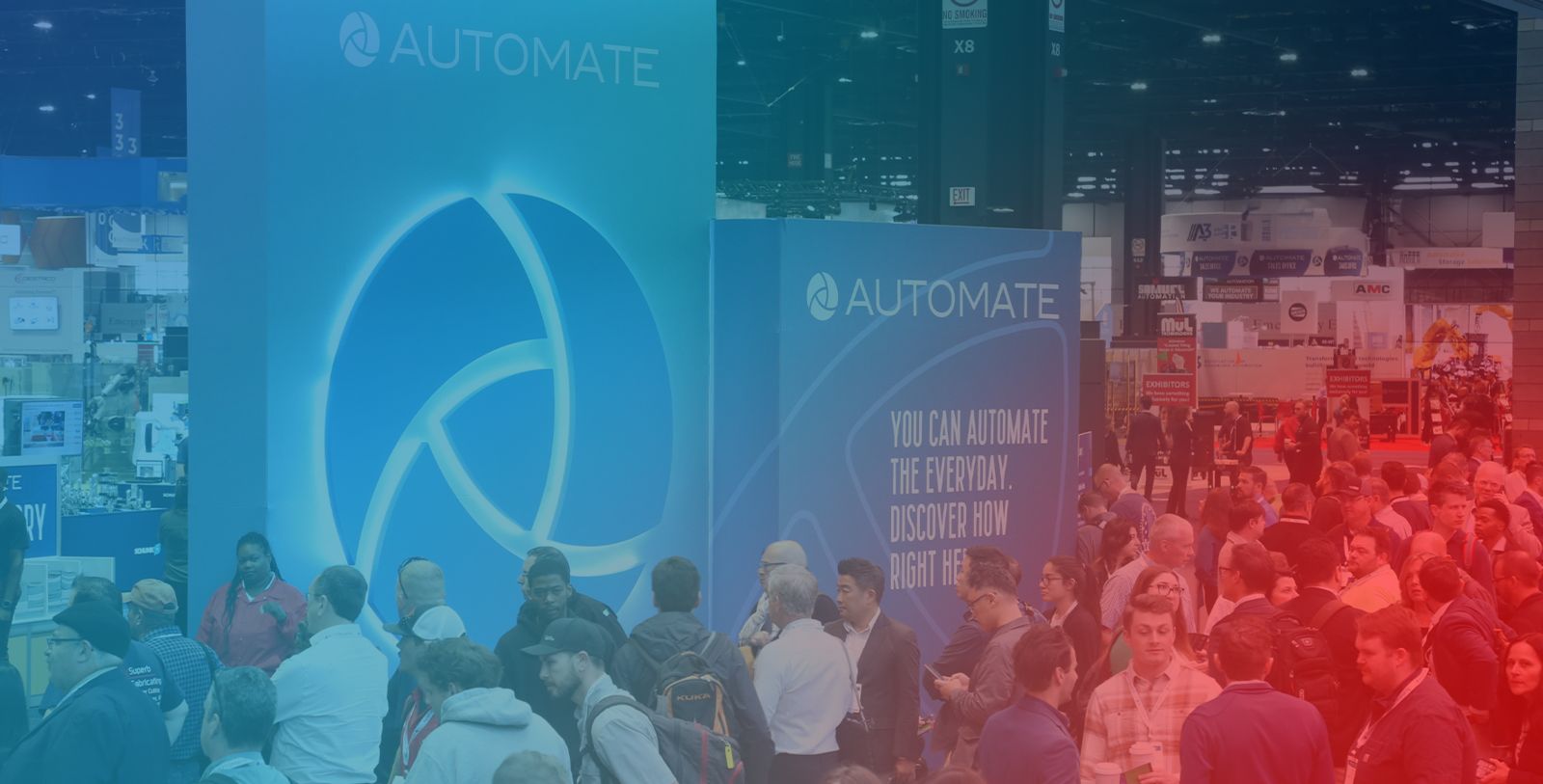
Field Notes · Chicago · June 2026
What I Took Away from Automate 2026
Industrial automation just took a giant leap — and the gap between the companies waiting and the ones committed is widening fast.
Based on my experience, I can honestly tell you that industrial automation has taken a giant leap in the past 12 months, and we’ve entered a new era of technological innovation.
Over my career, I’ve experienced two tectonic technology shifts that transformed every company and industry: 1) Mobile (3G, 4G, 5G, and the first iPhone) and 2) the Internet (remember AOL, Yahoo, and MySpace?). And now, AI, including machine learning, LLMs, vision, and physical robotics, is reshaping industries in the same way — arguably more dramatically.
The thing that struck me, and that I relate to in the way we train our software automations at AXI, came from one of the keynotes, by Evan Beard, co-founder and CEO of Standard Bots (which just closed a $200M funding round at a $1B valuation): the first and most important thing you need to understand is that the bottleneck to automation is DATA. You need good data to train the AI models that tell the robot how to do a task — accounting for your environment and, most importantly, the variability of the task and product.
So, if I want to learn golf, watching videos only gets me so far — at some point, I have to grab a club and actually swing. Training a robot is the same. You can record a worker doing the task and train a model on the footage, but the real learning comes from putting the hardware to work — running the task over and over, tuning the model, and improving with every rep.
Second, the number of companies that have automated key operational processes is strikingly low. Sure, Amazon, Ford, Honda, and Walmart have been investing billions for years on automation — but for most companies, the tech has been too capital-intensive and too complex to implement and support. That’s now changing, and changing fast. There are solutions that can meet the budgets of companies of virtually any size. Implementations are more standardized, hardware and software are bundled, and AI models are pretrained on common tasks.
My final takeaway
Two years ago, “end-to-end automation” was a sales pitch. I can confirm it’s becoming real — the technology is within reach. Automation is getting smarter fast. ML, vision, LLMs, and connectivity — hardware and software alike — will be the nervous system of next-generation operations.
It’s now time — start planning, learning, and trialing solutions — because the gap between the companies that are waiting and those that are committed is widening fast.
A few of the companies I connected with and would recommend, in case any are useful to you. Always happy to make an introduction:
Robotics & Cobots
- Standard Bots — Evan Beard’s keynote on physical AI was a highlight; U.S.-built, configure-to-order cobots
- Doosan Robotics — collaborative robotics with serious integration muscle
Machine Vision AI
- Apera AI — 4D vision for bin picking and robotic guidance
- Roboflow — the computer vision developer platform
- Gather AI — autonomous inventory intelligence
- Lincode — visual inspection AI for the production line
Control & Motion
- Beckhoff Automation — PC-based control and EtherCAT automation
- LinMot USA — linear motor and actuator technology
Industrial Data & IIoT
- HighByte — industrial DataOps connecting plant-floor data to the enterprise
Systems Integration
- Flex-Line Automation, Inc. — custom conveyor and material-handling systems built to spec
- IAR Group — robotics & automation integration
Material Handling
- FlexLink, a Coesia company — conveyance and flow
- MûL Technologies — plug-and-play autonomous robotic carts
- SEW Eurodrive — autonomous pallet-mover robots
Machine Safety
- Safe-T-Sense, LLC — machine safeguarding done right
- EUCHNER USA, Inc. — safety interlocks and guard-locking systems
Some of you are already deep into automating; others are just beginning. What matters is having a plan because the technology landscape is changing faster than ever. I’d genuinely enjoy helping you build one: a practical technology roadmap that fits your operations, budget, and strategic objectives. That’s the work we do at AXI every day.